Blog
Booking platform developer Philippines — salon, laundry, and session scheduling from the ground up
How I build salon, laundry, clinic, and session booking in the Philippines — shared scheduling core, PHP backends, and SolverIQ as a live mentorship example.
As a booking platform developer in the Philippines, I build salon, laundry, clinic, home-service, and session scheduling products — the kind where availability, buffers, cancellations, and payment timing all have to agree before anyone sees a pretty calendar UI.
Booking products look simple on the surface — pick a time, pay, show up. Underneath they are state machines: provider calendars, admin overrides, and edge cases that inflate post-launch support.
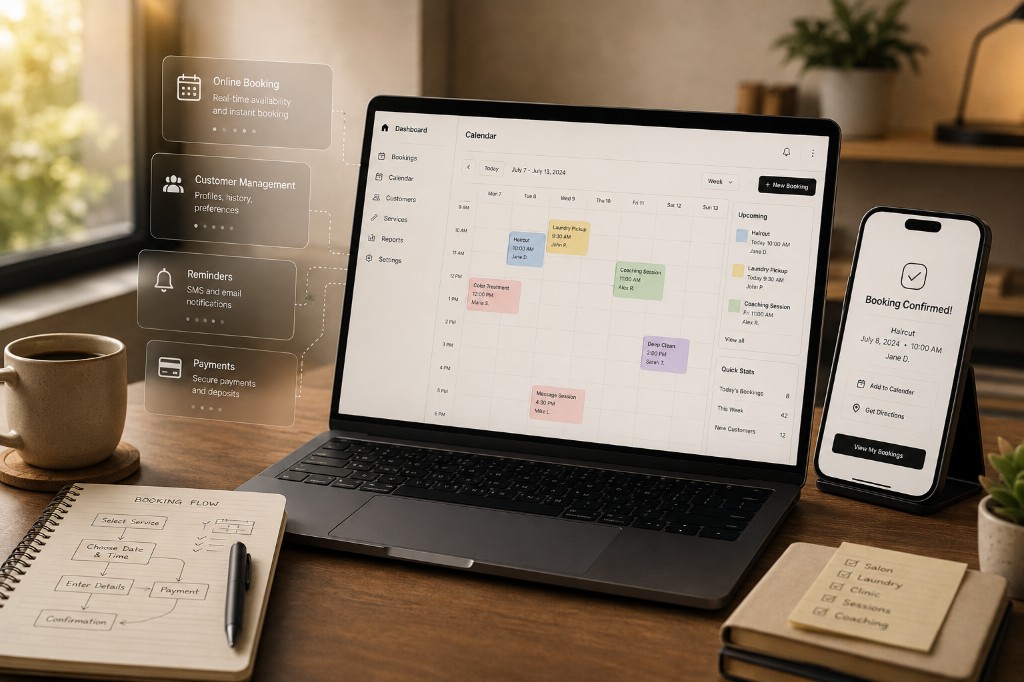
I build these in the Philippines — salon chairs, laundry pickup windows, clinic slots, home-service visits, and paid mentorship sessions. SolverIQ on my work page is a live session-booking example for Ideyator Ventures; the SolverIQ case study walks through it in more depth. For the service breakdown, see booking services expertise and web development.
Who this is for: founders planning a booking product, agencies scoping salon or laundry apps, and technical leads comparing build vs buy.
The shared scheduling core
Different verticals, same bones:
| Vertical | What gets booked | Who manages availability |
|---|---|---|
| Salon / spa | Stylist or room + service menu | Shop admin |
| Laundry | Pickup / delivery window | Shop or courier admin |
| Clinic / home service | Provider slot + travel buffer | Provider + ops |
| Sessions / coaching | Mentor or expert slot | Platform admin |
Consumer flow rhymes: browse services → pick slot → pay or hold → confirmation → reminder → complete or cancel. Admin flow rhymes: set hours, block dates, manage staff, see today's board.
That is why SolverIQ — mentorship sessions — still teaches you something about salon booking. Different catalog; same calendar discipline.
Web first, mobile when volume demands it
Many platforms start in the browser: booking page, shop admin, payment hook. Cordova apps come when providers and customers live on their phones daily — same PHP API, Framework7 UI on top. I have shipped both patterns; see mobile app development and Framework7 & Cordova.
Do not assume mobile on day one unless the brief requires it. A solid web booking loop with admin often proves the product before store releases eat timeline.
Backend: where booking breaks if you rush
Typical failure modes I design against:
- Double booking — two customers same slot because availability was not locked
- Timezone drift — reminders fire at wrong local time
- Payment vs confirmation order — charged before slot is actually held
- Provider overrides — admin moves an appointment but customer app still shows old time
Native PHP + MySQL is my production default for mobile backends and web products. I draft with AI, then review SQL, locks, and auth myself — same workflow as my PHP mini-framework post. For hire scope, full stack PHP.
Process flow before pixels
I still start on paper or a whiteboard: roles (customer, provider, admin), happy path, cancel path, no-show path, payment path. Booking UX is easy to mock; edge cases are what inflate post-launch support.
Questions I ask early:
- Can customers reschedule themselves or only admin?
- Is payment upfront, deposit, or pay-at-venue?
- Do providers have individual calendars or one shop calendar?
- What happens when a provider is sick mid-day?
Answers change the database shape more than the color palette.
AI speed, human release
AI helps me draft admin screens, slot-picker components, and data APIs faster. It does not get to skip the review on concurrency, refunds, or notification copy. Fast drafts, careful release — same rule as every other product I ship.
If you are comparing AI-augmented vs traditional delivery for web booking, this post on AI web developers is the longer hiring lens.
Not ride hailing
Clients sometimes conflate booking with on-demand dispatch. Ride hailing is live trip state — rider, driver, map, fare. Booking is scheduled time. I build both; the architecture differs. See ride hailing expertise for the dispatch side.
Ballpark scope (honest, not a quote)
A single-shop salon web booking with admin might be a phase-one scope. Multi-branch, laundry logistics legs, home-service routing, and consumer mobile adds phases. Email me scope — dexbanastao@gmail.com — or use contact and I will tell you straight what fits.
Related on this site
- Booking services expertise — features, process flow, FAQs
- SolverIQ case study — live session booking
- Web development services
- Work portfolio
FAQ
What does a booking platform developer in the Philippines build?
Salon and spa slot booking, laundry pickup windows, clinic appointments, home-service visits, and paid session products like mentorship — usually web admin plus consumer booking, with Cordova mobile when volume justifies it. Every build starts with a signed-off process flow (book, confirm, cancel, no-show, pay) before Framework7 screens or PHP APIs. See booking services expertise for the full feature list.
Is booking software the same as ride hailing?
No. Ride hailing is live trip dispatch — rider, driver, map, fare. Booking is scheduled time. I build both; the architecture and UX differ. See ride hailing expertise for dispatch products.
What is the difference between salon and laundry booking software?
Same scheduling core — slots, services, payments, reminders — with different rules. Salon uses stylist or room buffers; laundry uses pickup and delivery windows and wash status legs. Process flow captures the vertical before build.
Can booking platforms handle paid sessions like mentorship?
Yes — SolverIQ on my work page is one live example. Pick a slot, pay, confirm. Different catalog from salon booking; same API pattern for availability and checkout.
Do you build mobile apps for booking products?
When volume justifies it — Cordova consumer apps for reminders and rebooking; web admin for shop calendars. Web-only is fine for low-frequency appointments.
What breaks if you skip process flow on booking builds?
Double bookings, unclear cancel rules, staff calendars that disagree with customer UI, and payment taken without a confirmed slot. I document states before Framework7 screens or PHP APIs.
How do reminders work in booking platforms?
Push, SMS, or email depending on scope — triggered from confirmed appointments and cancellation policies defined in process flow. Hostinger cron or queue jobs fire the schedules.
Can one platform serve salon, clinic, and home service?
Yes with scoped rules per vertical — not one template pretending all businesses are identical. Service catalog, slot length, and buffers change; the engine stays shared.
What should I send when hiring a booking developer?
Vertical (salon, laundry, clinic, sessions), role list, payment methods, cancel policy, staff vs resource scheduling, and mobile vs web priority for the first launch.
How long does a booking platform first version take?
Depends on payment integration, staff calendars, multi-branch, and mobile scope. Documented flow and a agreed feature list compress timeline; vague “like App X” does not.