Expertise
Food delivery
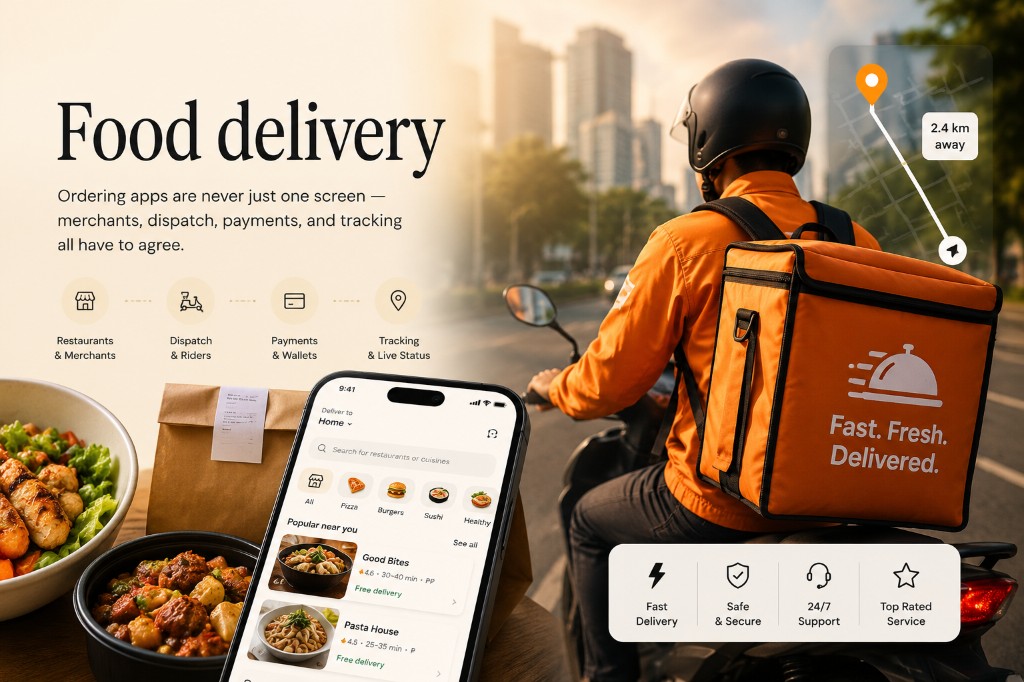
Food delivery app developer in the Philippines — ordering apps where merchants, dispatch, payments, and tracking all have to agree, never just one screen.
Production platforms in these domains ship at Diverse System Solution Inc. (DSSI), where I'm Senior Mobile Developer. This site is my portfolio and freelance lane — DSSI is the company behind most live delivery, ride, logistics, booking, and commerce work. (opens in new tab)
- Merchant & admin portals
- Order management & dispatch
- Cart, checkout, and payments
- Consumer mobile & web apps
Features & roles
Food delivery is multi-role by default. Customers browse menus and track orders. Merchants manage the menu, accept or reject orders, and mark food ready. Riders get dispatch, navigation, and proof of delivery. Admin or ops handles disputes, promos, zones, and reporting.
Core features: restaurant discovery, menu and options, cart and checkout, payment, order status timeline, tracking, ratings, notifications, and merchant onboarding. Marketplaces add commission and payout views for admin.
End-to-end process flow
Customer places order → merchant accepts (or auto-accept) → kitchen prepares → ready for pickup → rider assigned → rider en route → picked up → delivered → completed → payout and rating. Each step is a status that the server and all apps must agree on.
I draw this flow with you first, then map statuses to screens. Dispatch rules (manual vs automatic) change per product — the flow diagram is where we lock that before anyone writes code.
Where this ships in production
I lead mobile and full-stack work on live platforms at DSSI (Diverse System Solution Inc.) in the Philippines — food delivery, ride hailing, logistics, booking, e-commerce, and member portals. The flows and notes below come from that production work.
dexterbanastao.com is my portfolio and hire-me lane. For the company behind most of this delivery, ride, and commerce software, see dssi.international — context in the DSSI blog post.
How I run the project (workflow)
I don't jump straight to screens. Every build starts with a process flow — who does what, in what order, and what status everyone sees at each step. That becomes the shared map for you, me, the server team, and testing.
Typical sequence: discovery call → list of roles and features → you sign off on the process flow → backend connection plan → mobile and web screens per role → connect everything → App Store or web launch → handoff notes. AI speeds up first drafts at each step; your sign-off stays human.
You get visibility at each step — not a black box and a surprise at launch.
Mobile apps — one build for iPhone and Android
For production mobile I use Framework7 and Cordova — one codebase that becomes apps in the Apple App Store and Google Play, with native features (camera, GPS, push notifications, file upload) where the product needs them.
I usually split by role: customer app, merchant or provider app, rider or courier app, and sometimes a lightweight admin app. Each role sees the right screens; all roles read the same order or job status from the server.
Before store submission I test on real phones — cold start, background resume, location permissions, and slow network on the paths that matter for your business.
Keeping the server team aligned with the same plan
I'm not siloed on mobile while the server team guesses what data each screen needs. I lead with the signed process flow and a written backend connection plan — who can do what, each status name, and what data each screen expects.
What the server team receives: a status diagram (order, trip, booking, or shipment steps), examples of data in and out, which role calls which function, and what happens when login fails or a step is invalid. PHP and MySQL on the server; secure database access; handlers that match what mobile and web already built against.
During build I review server changes for mismatches — renamed fields, missing statuses, login gaps — before testing wastes a week. When the plan must change, we update mobile and server in the same sprint. That coordination is how multi-role platforms stay in sync in production.
Full product delivery with AI-assisted workflow
On solo or lead work I own mobile, the server connection plan, and often the PHP layer behind it. AI-assisted workflow means clear project rules in the repo — how screens should look, how the server should respond, security boundaries — plus repeatable playbooks for adding a screen or a payment step.
AI drafts mobile pages, server boilerplate, and PHP logic from the signed process flow. I review every change for security, plan alignment, and store rules before release. Other developers on the project get the same rules so output stays consistent.
Fast first drafts, careful launch — whether the product is delivery, booking, or a member portal. See AI engineering and AI engineer services.
Building food delivery?
I lead this work in production at DSSI. Contact me here for freelance scope — or visit DSSI for company-led platform delivery. (opens in new tab)
FAQ
Questions I get asked
What does a food delivery app developer in the Philippines build?
Multi-role delivery software — customer ordering, merchant tools, rider dispatch, admin ops, and PHP backends that keep order status in sync. Process flow and backend connection plan come first; mobile apps per role follow. See the food delivery blog for own-app vs marketplace tradeoffs.
Can you build something like the big delivery apps?
The building blocks — multi-role portals, dispatch, tracking, payments — yes. Timeline and budget depend on how much you need at launch vs added later.
Do you document the order flow before coding?
Yes — we agree on the process flow and status diagram first, then the backend connection plan, then mobile screens per role. That is how merchant, rider, and customer apps stay aligned with the server.
Do you build mobile apps for iPhone and Android?
Yes — Framework7 and Cordova is my production approach for multi-role delivery, ride, booking, and logistics products. One codebase for both app stores, with store publishing when the product is ready.
How do you keep the server team aligned with mobile and web?
Process flow and backend connection plan first — status names, data examples, role permissions — then parallel mobile and server work. I review server changes for mismatches before testing so apps and server stay aligned.
Where does AI fit in full product delivery?
AI drafts mobile screens, server boilerplate, and PHP logic from the signed process flow. Project rules keep patterns consistent; I review every change for security and plan alignment before launch.
Is this work through DSSI or just freelance?
Production delivery, ride, logistics, booking, and commerce platforms ship at DSSI (Diverse System Solution Inc.) — dssi.international — where I'm Senior Mobile Developer in the Philippines. dexterbanastao.com is my portfolio and direct contact for freelance or collaboration.
Do you work with teams outside the Philippines?
Yes. I'm based in the Philippines and work with local teams and remote clients. English is fine, and I'm used to coordinating across time zones on production teams and direct collaboration.
Related
- Mobile app development
- Ride hailing
- Logistics & delivery
- E-commerce
- DSSI — the company behind most of my production mobile and platform work in the Philippines
- Own restaurant app vs multi-merchant food delivery platforms — Philippines compared
- React Native with zero knowledge — how I use AI, rules, and skills to build from scratch
- Native PHP in 2026 — building a tiny backend skeleton with AI (and knowing when to stop)
- About me