Blog
Ride hailing platforms in the Philippines — how they work, what ops needs, and per-trip cost
Ride hailing app developer Philippines — trip flow, ops requirements, maps and payment costs per trip, and building platforms that survive real traffic.
You tap Book ride. Somewhere a driver's phone buzzes. Someone in ops watches a map with three hundred moving dots. Money moves before anyone says thank you.
That's ride hailing in the Philippines — not magic, but state machines, location streams, pricing rules, and humans on chat when rain hits EDSA.
In the Philippines you'll know names like Grab (cars and the super-app bundle), Angkas, Joyride, and Move It (motorcycle rides in traffic cars can't beat). I'm not ranking brands against each other — same hard problem: match rider and driver fast, price fairly enough, pay out correctly, and don't lose your shirt on every promo.
I'm a ride hailing app developer in the Philippines — rider and driver apps, admin dashboards, PHP backends, Framework7 + Cordova in production. That work ships day to day at DSSI (Diverse System Solution Inc.). Below: how these platforms actually work, what operations need on day one, where money leaks per trip, and what I'd scope on a freelance build.
Not a pitch to clone a national app in a weekend. A builder's map.
Ride hailing expertise · mobile app development · about · work
Who this is for: founders scoping a ride or motorcycle-taxi product, ops leads joining a startup, investors who want unit economics beyond the pitch deck, and developers who've only seen the rider UI.
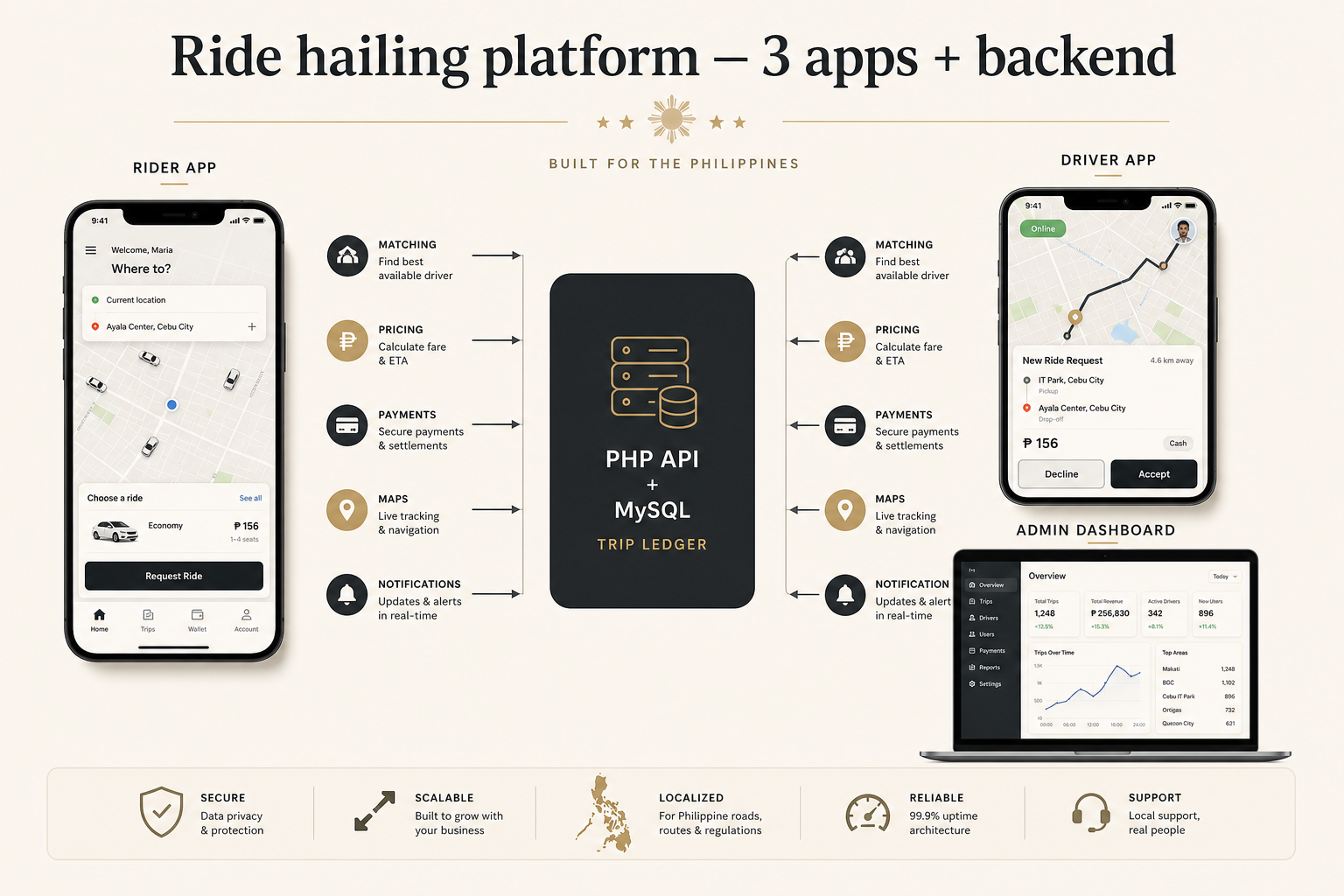
What you're really building — three apps and a nervous system
A ride platform is never "one app."
| Surface | Who uses it | Job |
|---|---|---|
| Rider app | Passenger | Request, see fare estimate, track, pay, rate |
| Driver app | Partner / biker / chauffeur | Go online, accept trips, navigate, complete, earnings |
| Admin / dispatch | Ops, support, finance | Live map, overrides, fraud checks, payouts, promos |
Behind them: matching, pricing engine, trip state, payments, notifications, maps, payout ledger, support tickets.
Miss one leg and you get the classic failure modes — driver arrived but app says searching, double charge, rider cancelled but driver not paid, surge stuck on from yesterday.
How a trip works — the state machine everyone must agree on
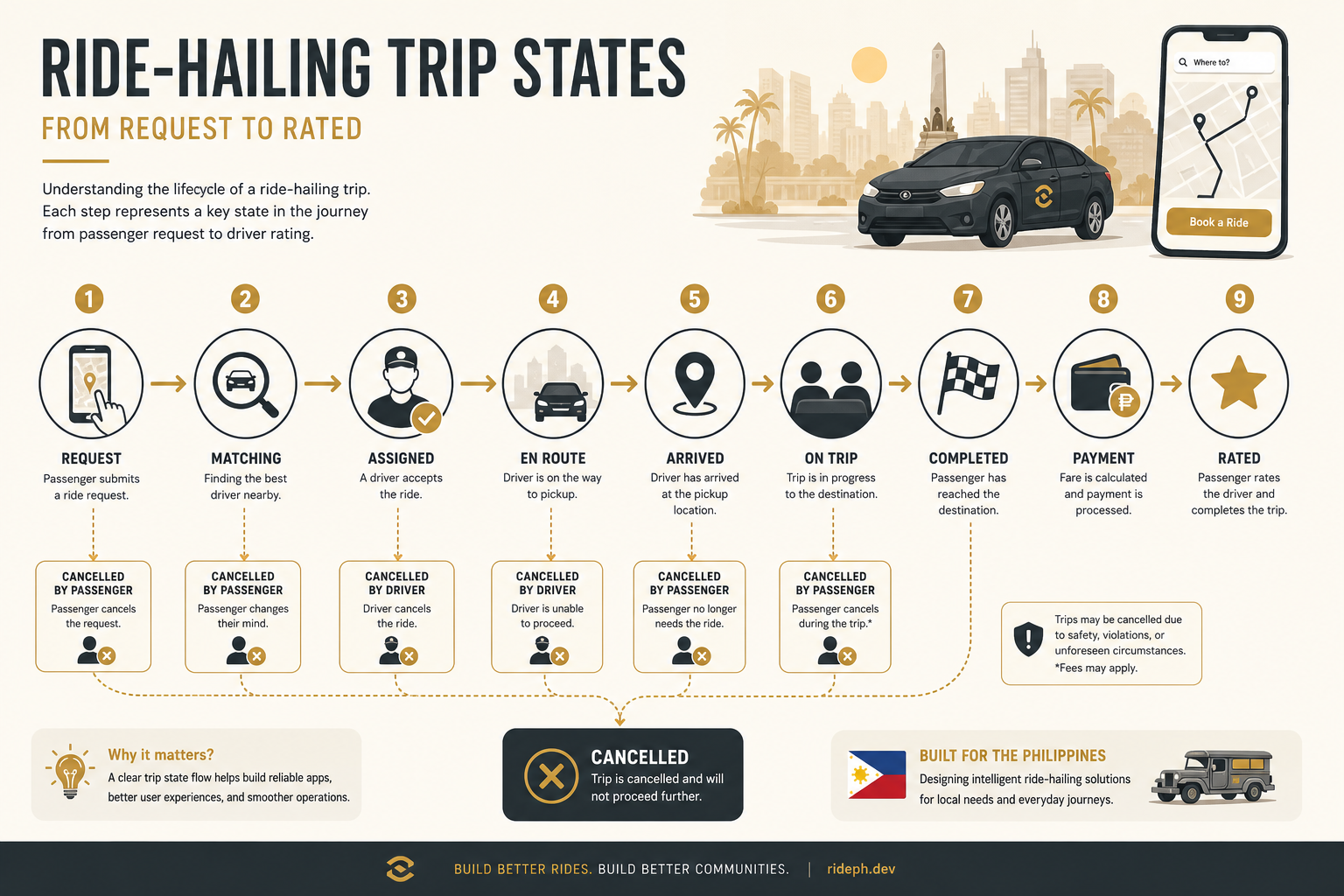
Every platform rhymes. Example flow:
Rider requests → Matching → Driver assigned → Driver en route
→ Arrived → Trip started → Trip ended → Payment captured → Payout queued → Rated
Cancellation branches at almost every step — rider no-show, driver no-show, wrong pin, unsafe area, payment failed.
| State | Rider sees | Driver sees | Ops cares about |
|---|---|---|---|
| Searching | Spinner / finding driver | Offer or ignore | Supply in zone |
| Assigned | Driver name, plate, ETA | Pickup pin, navigate | Match quality |
| Arrived | "Driver is here" | Start trip button | Wait time |
| On trip | Route, share trip | Navigation, end trip | GPS sanity |
| Completed | Receipt, rate | Earnings update | Fare audit |
| Cancelled | Reason, fee? | Compensation rule? | Abuse patterns |
Real-world requirement: rider, driver, and admin must read the same state. PHP backend + mobile apps I ship treat this as the contract — not a suggestion in a Notion doc.
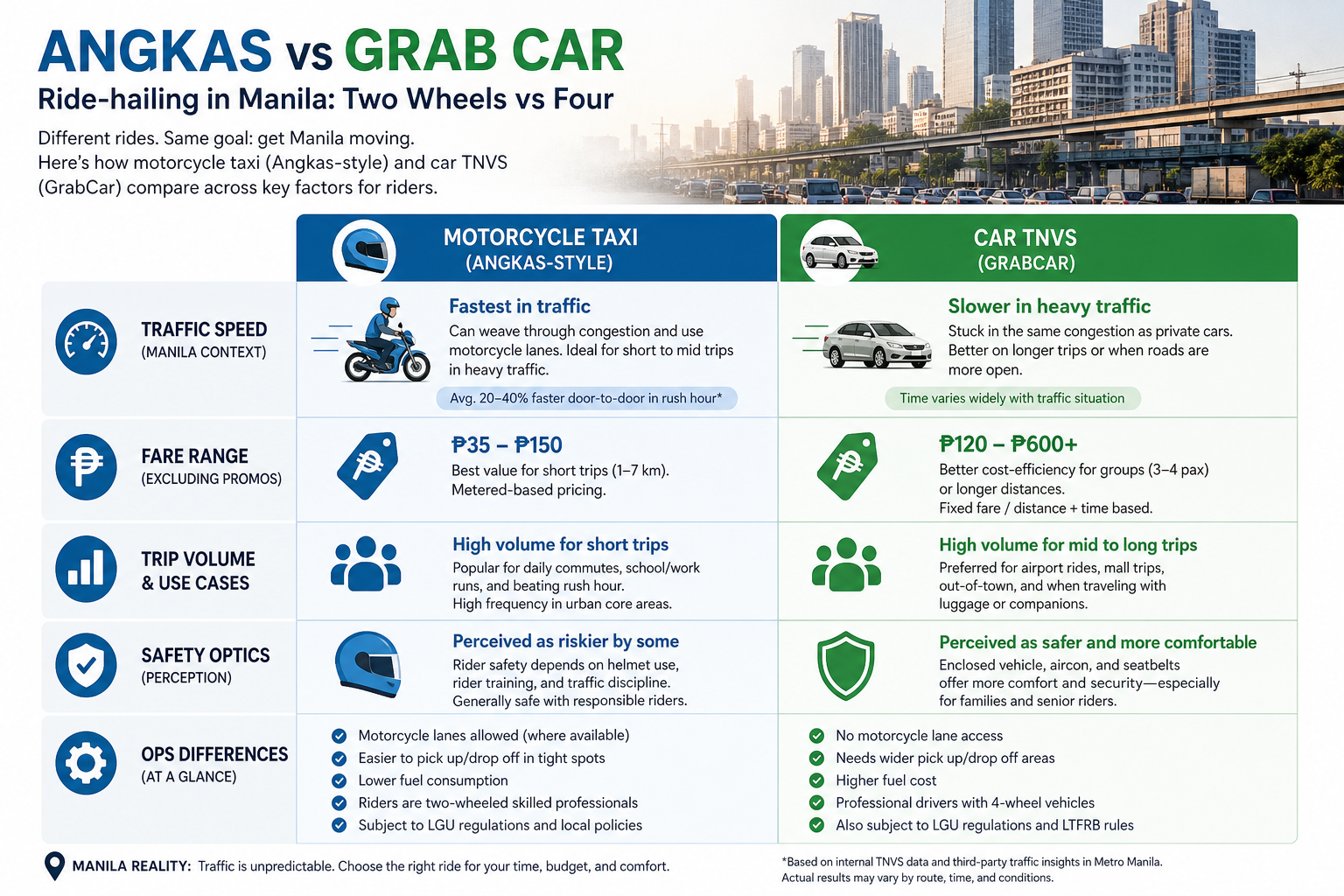
Motorcycle platforms (Angkas, Joyride, Move It) add: helmet rules, habal-style pickup points, smaller radius matching, rain surge. Car platforms (Grab car) add: larger ETAs, airport queues, TNVS compliance fields.
Same bones. Different ops playbook.
Matching and pricing — where platforms win or bleed
Matching
- Geo buckets — divide city into cells; only ping drivers in cell + neighbors
- Accept timeout — offer expires in 15–30 seconds; cascade to next driver
- Supply/demand — not enough drivers online → longer wait → rider churn
- Fraud — fake GPS, account farming, collusion rings
Ops requirement: dashboard showing online drivers per zone and accept rate. Without it you're flying blind every Friday rain.
Pricing
- Base fare + distance + time + booking fee
- Surge when demand > supply
- Promo codes (subsidized — someone pays the gap)
- Cancellation fees and no-show rules
- Platform commission % vs driver take-home
Founders always ask for "simple flat rate." Ops always needs surge, promos, and airport exceptions within month two.
Philippines context — cars, motorcycles, regulation
| Platform type | Examples | Reality on the ground |
|---|---|---|
| Car / TNVS | Grab car | Airport rules, franchise context, longer trips, higher ticket |
| Motorcycle taxi | Angkas, Joyride, Move It | Traffic speed, lower fare, higher trip count, safety optics |
| Multi-modal super-app | Grab (food + ride + pay) | Cross-sell, wallet float, unified identity |
I'm a developer, not a lawyer. TNVS, LTFRB, and motorcycle-taxi policy shape what fields you collect in driver onboarding and what reports admin exports — product and legal define that; I wire the forms, document uploads, and approval queues.
Building for one city and one vehicle type first is how you meet ops requirements without drowning in edge cases.
What operations need from software — day one vs month six
Day one (launch corridor):
- Driver KYC upload + manual approve/reject
- Rider OTP login
- Live trip list with phone call mask or in-app chat
- Manual trip cancel + refund with reason codes
- Daily driver payout report (even if payouts are manual bank transfer at first)
- Incident flag — safety, harassment, accident
Month six (scale hurts without these):
- Auto-matching tiers and heatmaps
- Surge editor by zone
- Promo engine with caps and fraud limits
- Driver incentives (quests, guaranteed earnings — expensive)
- Dispute workflow — fare adjust, wallet credit
- SLA dashboards — wait time P95, cancel rate, completion rate
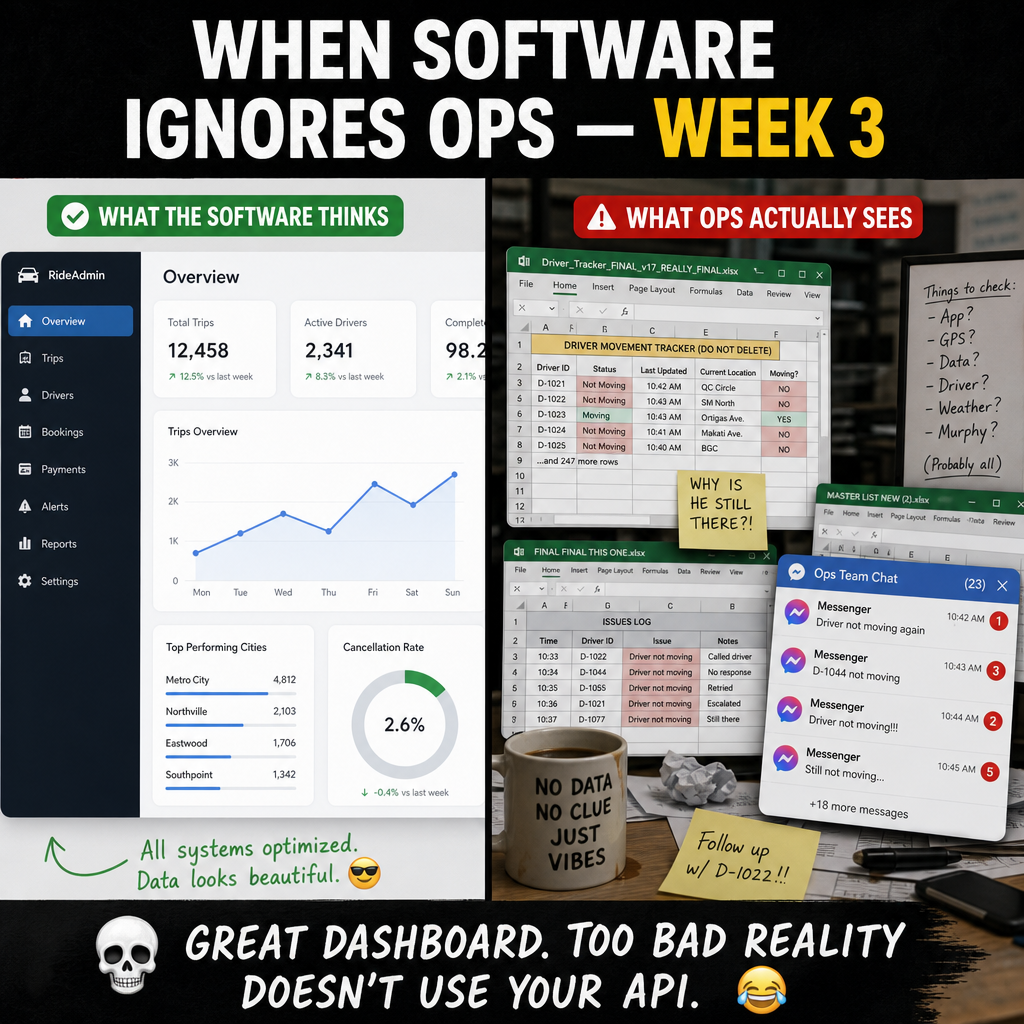
Software that ignores ops becomes Excel + Messenger in three weeks. I've seen it.
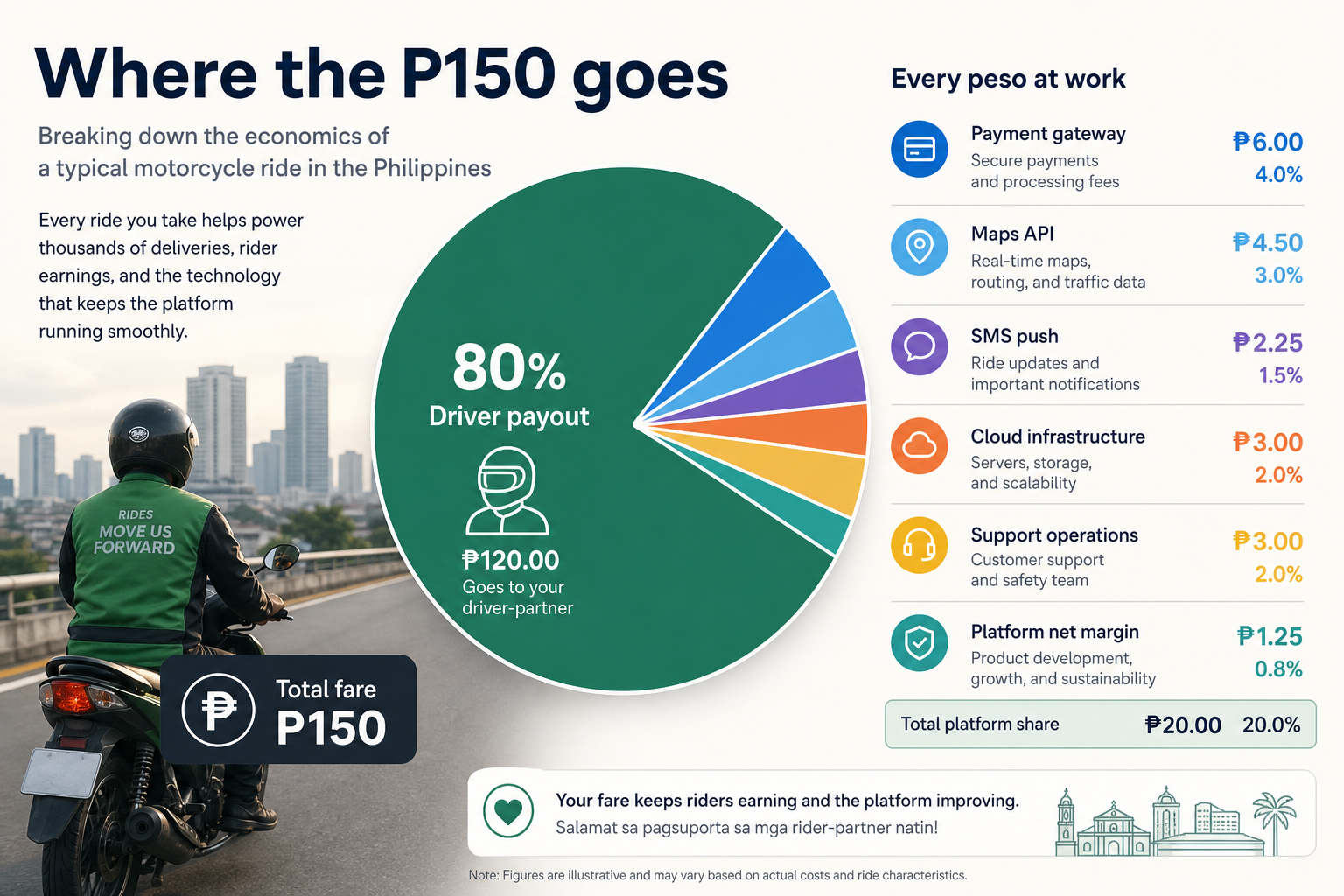
The ₱150 motorcycle trip — where costs hide
Illustrative math only. Your city, vehicle, and contracts will differ. Goal: show why promos hurt and why infra isn't free.
Assume: rider pays ₱150 all-in on a motorcycle trip. Platform keeps 20% commission → ₱30 gross platform revenue.
| Cost bucket | Illustrative range | Notes |
|---|---|---|
| Driver payout | ₱120 (80%) | Often the largest line — incentives stack on top |
| Payment gateway | ₱3–₱6 (~2–4%) | Cards, e-wallets, failed retry fees |
| Maps & routing | ₱2–₱8 per trip | Google / Mapbox / HERE — scales with API calls |
| SMS / OTP / push | ₱0.50–₱2 | Login, trip events, marketing if you're careless |
| Cloud & bandwidth | ₱1–₱4 allocated | Location pings add up at volume |
| Support & ops | ₱5–₱15 allocated | Humans cost money — chat on cancel disputes |
| Insurance / safety fund | ₱0–₱10 | Varies by operator model |
| Promo subsidy | ₱0–₱50+ | If rider used a discount — platform eats it |
| Driver incentive bonus | ₱0–₱30 | Quests, rain bonus, sign-up guarantees |
On paper ₱30 commission. After variable costs you might net ₱5–₱15 — or lose money if promo + incentive + rain bonus all fired on the same trip.
That's why Grab runs a super-app wallet and food delivery. Ride alone at ₱150 is a volume game.
Car trips (₱250–₱800+) spread fixed API costs thinner. Motorcycle trips need insane completion volume or subsidy discipline.
Third parties you'll pay whether you like it or not
| Vendor | What you buy | Builder note |
|---|---|---|
| Maps | Geocode, route, distance matrix, tiles | Cache routes; don't ping every second blindly |
| Payments | Pay-in, refunds, split payouts | Idempotency keys — double charge = viral Facebook post |
| SMS / OTP | Login, driver verify | Rate limit; watch SMS fraud |
| Push (FCM/APNs) | Trip offers, status | Driver must get offer push in 2 seconds |
| Cloud | API servers, DB, Redis, queues | Location writes are write-heavy — plan DB shape |
| KYC / identity (optional) | Document verify | Or manual review queue at first version |
| Analytics / crash | Stability | Non-negotiable before 1,000 drivers |
Cutting maps quality to save ₱2/trip sounds smart until drivers take wrong routes and cancel rate spikes.
Implementing in the real world — how I'd roll it out
First launch — Prove corridor (4–8 weeks product scope, not calendar promise)
One city zone. Motorcycle or car — not both. Rider + driver app + minimal admin. Manual matching fallback. Cash or single payment provider. PHP API + MySQL trip ledger.
After launch — Ops survival
Auto-matching, surge, promo caps, payout CSV, dispute reasons, basic fraud flags (same device rider+driver, impossible speed).
Scale-up — Scale
Heatmaps, incentive engine, multi-city, airport/geofence rules, deeper analytics.
Framework7 + Cordova for driver/rider store apps when you need installs; web admin from day one. Same backend patterns as my food delivery and logistics work — different vehicle, same dispatch brain.
Backend depth: PHP mini-framework post. AI-assisted first drafts with human review on payments and trip state: AI web developer pros/cons.
What founders get wrong (and ops feels immediately)
- "Uber UI but cheaper" — no matching rules, no cancel policy, no payout spec
- Promos before unit economics — buying trips you can't afford
- Driver app without offline behavior — tunnels and dead spots are real
- No admin on launch — support drowns in "driver not moving" tickets
- Ignoring rain — Manila weather is the surge product

- One app for rider and driver — fraud magnet; separate roles, separate logins
What I build — ride hailing platforms in the Philippines
I ship production ride and dispatch software — not slide decks.
| Deliverable | Included |
|---|---|
| Process flow | Trip states, cancel tree, payout rules documented first |
| Rider app | Request, estimate, track, pay, history, support entry |
| Driver app | Online toggle, offers, nav hook, complete, earnings |
| Admin | Live trips, manual override, driver approval, reports |
| Backend | PHP + MySQL, role auth, audit-friendly admin actions |
| Launch review | Payments, location edge cases, state bugs before store submit |
Not included: guaranteeing you'll out-Grab Grab, legal franchise advice, or driver recruitment.
→ Ride hailing expertise · Mobile development · Full stack PHP · Contact
Send vehicle type (car vs motorcycle), launch city, expected trips/day, payment model, and whether matching is auto or manual at first version. I'll tell you if the scope is realistic — or if you need ops hires before another developer hour.
Bottom line
Grab, Angkas, Joyride, Move It — different logos, same hard problem: move two strangers together safely, price it, pay driver, keep state honest.
The app is the visible part. Ops, unit economics, and third-party bills decide if the company survives.
Build the state machine first. Respect the ₱150 trip math. Launch one corridor. Then scale.
That's the ride hailing work I do.
Related on this site
- Ride hailing expertise
- Logistics expertise — shared dispatch patterns
- Food delivery blog — marketplace economics cousin
- Work portfolio
FAQ
How does a ride hailing platform work in the Philippines?
Rider requests → matching → driver assigned → pickup → trip in progress → complete → pay → rate. Rider app, driver app, and admin share one trip status enum — drift between surfaces causes support nightmares.
What is the difference between car and motorcycle ride apps?
Same state machine shape; different ops, safety rules, pricing, and corridor density. Motorcycle products (Angkas-style) win in traffic cars cannot beat; car products need different insurance and matching rules.
How much does each trip cost the platform to serve?
Maps, payments, SMS, cloud pings, support, and promos eat margin — a ₱150 trip may leave little after third-party bills. Unit economics matter before scale. See per-trip math section above.
Do I need separate rider and driver apps?
Yes for production — one login per role reduces fraud and simplifies permissions. Admin is web for ops and finance.
What maps and payment APIs are required?
Distance and routing for estimates; payment gateway for cashless; payout ledger for drivers. Quote wrong and you subsidize every trip or anger partners.
Can a startup out-Grab Grab?
Not by copying UI alone. National apps won on capital, density, and ops. Startups win on one corridor, one vehicle type, and honest unit economics — not a weekend clone.
What should I send when hiring a ride hailing developer?
Vehicle type, launch city, trips per day estimate, payment model, auto vs manual matching at first version, and cancel policy.
How long does a ride hailing first version take?
Months with documented trip flow, three surfaces, and backend — not weeks. Promo spend before ops is ready burns cash faster than dev invoices.
What stack do you use for ride hailing apps?
Framework7 and Cordova for rider and driver apps; PHP and MySQL for trip state and admin — production patterns from ride hailing expertise.
What is the most common founder mistake?
Launching promos before matching rules, payout spec, and admin tools exist — ops drowns while the app looks finished.