Blog
Full-stack JavaScript with AI — React, PHP, and Hostinger from planning to production
AI-assisted full-stack JavaScript in the Philippines — same scope as a 12-month build in 3 months. React UI, PHP backend, Hostinger, errands + booking.
AI-assisted full-stack development in the Philippines means building the same product you would have scoped for twelve months — customer screens, admin tools, payments, bookings, reports — in roughly three months, with go-live at the end of month three.
In plain terms:
- React — what your customers and staff see in the browser (booking pages, dashboards, forms).
- PHP — the server side that saves data, runs business rules, and connects to payments.
- Hostinger — where the live site and database are hosted.
This is not a smaller or “trial” version of your product. It is the same feature list, delivered faster because AI helps draft screens, backend logic, and documentation — while a senior developer still reviews security, payments, and sign-off before launch.
Traditional builds without AI often spread the same work across twelve months: planning for three months, customer screens for three more, backend for three more, then testing and launch in the final months. AI-assisted delivery front-loads planning, builds customer and admin screens alongside the backend, and lands on production deployment in month three.
I build this way on client work and on production-grade products — errands and booking services platforms where customers schedule salon or laundry slots and book on-demand padala or home-service jobs in one system. AI engineering · web development · full stack PHP · booking services · logistics · about.
Who this is for: business owners and founders comparing a twelve-month agency quote to a three-month AI-assisted build — and anyone who wants a clear month-by-month picture without developer jargon.
Twelve months traditional vs three months AI-assisted
| Traditional (12 months) | AI-assisted (3 months) | |
|---|---|---|
| What you get | Full product as scoped | Same full product as scoped |
| Features | Booking, login, admin, payments, reports | Same — not a stripped-down launch |
| Go-live | Month 12 | Month 3 |
| What moves faster | — | First drafts of screens, backend logic, docs, checklists |
| What does not move faster | — | Your decisions, legal/payment approvals, final testing sign-off |
Without AI, teams still spend weeks typing repetitive screens and backend code by hand. With AI plus a clear project playbook (how the product should work, what to avoid, repeatable tasks), those first drafts land in days — then a senior developer reviews every change before it goes live.
Honest limit: three months is not magic. It works when you agree on the process flow in month one and stick to it. It slips when requirements change every week, nobody signs off on decisions, or you are waiting on a bank, payment provider, or lawyer outside the build team.
The pipeline — plan, screens, backend, connect, launch
Every AI-assisted full-stack build I run follows the same chain:
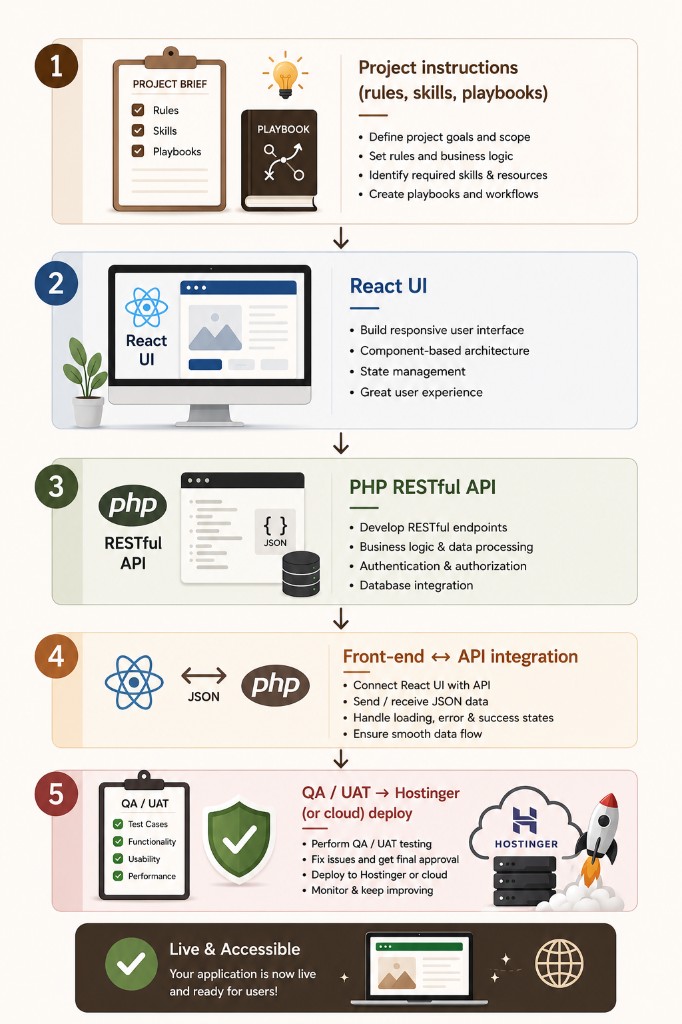
1. Project instructions first
Before any screens or backend code, we lock how the product should behave — not vague “make it modern” notes:
| What we define | Why it matters |
|---|---|
| Rules | Stack, security, naming — so AI output matches your product |
| Playbooks | Repeatable tasks — add a screen, add a payment step, add an admin report |
| Workflow | How AI sessions read your files and ask before big changes |
This matches the discipline on AI engineering. Nothing replaces a signed process flow (who does what, step by step) and a clear list of what the backend must return to each screen. Instructions keep every build session consistent after that.
2. Customer and admin screens (React)
The screens your customers and staff actually use — booking flows, dashboards, member areas, marketing pages. AI drafts layouts and forms from the signed process flow. I review whether the screens match your brand, are easy to use, and align with what the backend will deliver.
3. Backend and database (PHP)
The server that stores orders, users, slots, payments, and reports — usually PHP with MySQL, which runs well on affordable Philippine hosting. AI drafts the connection between screens and database; I review security, login rules, and payment handling before anything goes live.
4. Connect screens to the backend
Wire the customer app to real data — order status, login, payments, file uploads. We test each flow on a staging site before customers depend on it. One screen and one backend path at a time, so problems are caught early.
5. Launch on Hostinger (or your chosen host)
Publish the customer site and backend on Hostinger (or equivalent cloud) — secure connection (SSL), database, scheduled jobs, and smoke tests on the live URL. Launch is a milestone in month three, not an afterthought.
Three-month calendar — what happens each month
| Month | Focus | What you should see |
|---|---|---|
| Month 1 | Planning + customer and admin screens | Signed process flow, screen designs for main roles, review of how the product should look and feel |
| Month 2 | Backend built + connected to screens | Staging site with real login, bookings or orders, payments wired up |
| Month 3 | Testing, your sign-off, go-live | You test real flows, we fix issues, production launch on Hostinger (or agreed host), handoff notes |
Traditional twelve-month plans often leave “connect everything and test” for the last two months because screens and backend were built separately. AI-assisted delivery connects screens and backend in month two, so month three is for testing and launch — not starting integration from scratch.
Case study — errands and booking services platform
A combined errands and booking services platform shows how this works in practice. Customers book scheduled services (salon chair, laundry pickup window, clinic slot) and on-demand errands (padala, package pickup, home-service visit) in one product. Different experiences on the surface; one backend and one customer website underneath.
Who uses the system:
| Role | What they do |
|---|---|
| Customer | Pick a time slot or request an errand → pay → track status → confirm completion |
| Provider / courier | Accept jobs, update availability, mark pickup and delivery |
| Admin / ops | Calendars, dispatch board, pricing, reports, overrides |
What ships in three months:
| Piece | Errands + booking platform |
|---|---|
| Planning | Signed process flows for booking and errands before build starts |
| Screens | Customer booking, errand requests, provider board, admin dashboards |
| Backend | Slots, availability, job statuses, payments, notifications |
| Connection | One login and wallet across booking and errands — not two separate apps glued together later |
| Launch | Live on Hostinger (or agreed host) with SSL and tested happy paths |
The booking side matches salon, laundry, and appointment products; the errand side matches package and padala flows shipped in production at DSSI (Diverse System Solution Inc.). See booking services, logistics, and the booking platform post.
Why it matters if you are hiring: this is real complexity — two types of jobs, payments, admin, notifications — on one stack, with go-live in three months when the process flow is agreed up front.
Hostinger deployment — what business owners need to know
For many Philippine SMBs, Hostinger is a practical choice — website hosting, database, email, secure connection, predictable monthly cost.
| Piece | In plain terms |
|---|---|
| Customer website | Built files published to your domain or app subdomain |
| Backend | Runs on a separate address (e.g. api.yoursite.com) |
| Database | MySQL — orders, users, slots, stored securely on the server |
| Passwords and keys | Stored on the server only — never visible in the public website |
| Month 3 checks | Secure login for all roles, one full happy path per main flow, errors logged without exposing technical details to customers |
AI helps draft launch checklists; I verify hosting settings on your actual plan before go-live.
When three months still becomes twelve
- Changes that undo the signed process flow — new roles, payment rules, or screens that contradict what month one agreed
- Extra features added every week without updating the timeline or budget
- Delays on your side — slow sign-off, missing content, nobody available for weekly decisions in month one
- Waiting on others — payment provider, legal, or compliance approval outside the build team
Complex products — multi-merchant payouts, compliance screens, heavy integrations — are still buildable with AI-assisted React and PHP. Timelines stretch when the plan keeps changing or approvals stall, not because the product is “too hard for AI.”
Compare hiring models in AI web developer vs traditional.
What you get — summary
| Piece | Choice | How AI helps |
|---|---|---|
| Planning | Rules, playbooks, signed process flow | Consistent first drafts every session |
| Customer & admin screens | React | Layouts, forms, pages |
| Backend | PHP + MySQL | Data handling, login, reports |
| Connection | Screen ↔ server wiring | Fewer mismatches between UI and data |
| Hosting | Hostinger cloud / business | Launch checklists, SSL |
| Release | Testing + your sign-off | Security and regression review |
Honest fit
Good fit: the same feature list you would have given for a twelve-month project, React + PHP, AI-assisted workflow with senior review, Hostinger-friendly launch.
Poor fit: unlimited new features on a fixed three-month quote, or no involvement during planning.
Next step
Send your full feature list (the one you would have given for a twelve-month project), who uses the system (customer, staff, admin), payment methods, and hosting preference. Contact or read AI engineering for workflow scope.
Related on this site
- Booking services expertise — salon, laundry, clinic, home-service scheduling
- Logistics expertise — errands, padala, courier dispatch
- Booking platform developer post
- AI engineering — applied AI workflow and product integration
- Web development services
- Full stack PHP developer Philippines
- PHP mini backend with AI
- AI web developer vs traditional
FAQ
Can AI really deliver in 3 months what traditionally takes 12 months?
Yes — when the same scope is agreed in month one and AI speeds up first drafts of screens, backend logic, docs, and checklists. Go-live moves from month twelve to month three because connecting and testing start earlier, not because features are cut. Extra requests and slow approvals can still extend the timeline.
Is the feature set the same between traditional and AI-assisted delivery?
Yes. AI-assisted is not a “lite” version — it is the same booking, login, admin, payments, and integrations you specified, built with faster drafting and a tighter plan. An errands and booking platform is a typical example: scheduled slots plus on-demand jobs on one React + PHP system.
Why React plus PHP for a business website or app in the Philippines?
React is what customers and staff see in the browser — fast, interactive screens. PHP is the proven backend many Philippine products already run in production — affordable on Hostinger, good for reports, admin, and payment hooks. Together they cover the full product without overpaying for infrastructure on day one.
What are project instructions, rules, and skills?
The playbook before build starts — how the product should work, what AI must not do, and repeatable steps for adding a screen or a payment flow. They replace one-off chat prompts so every session matches your business rules, not a generic template app.
What is the 3-month month-by-month plan?
Month 1: planning and customer/admin screens. Month 2: backend built and connected to those screens. Month 3: you test real flows, we fix issues, production launch on Hostinger (or your chosen host).
How is an errands and booking services platform built from scratch to production?
Process flow signed first — how booking and errands work step by step. Month one: customer and provider screens. Month two: backend for slots, jobs, and payments wired to those screens. Month three: testing, your sign-off, live launch. See booking services and logistics.
Is Hostinger enough for a live business product?
For many small and mid-sized businesses, yes — database, secure connection, and a fast customer site on shared or cloud hosting. I match hosting to your traffic and backup needs; larger products may need upgraded infrastructure later.
Can AI write the whole backend without anyone checking it?
No. AI drafts backend logic quickly; a senior developer still reviews login security, payment handling, and whether screens receive the correct data. See PHP backend with AI.
What happens in month 3 — testing and launch?
You test real flows on staging, we fix issues, then production launch on Hostinger (or agreed host), secure login verified, and handoff documentation. Launch is the goal for month three — not “we will go live when budget allows.”
When is three months still unrealistic?
When the signed process flow stops being the agreement. Additions happen — but if every week brings new roles, payment rules, or customer journeys that contradict what month one locked, testing restarts and the calendar slips. Delays on your side matter too: slow sign-off, missing content, or weeks waiting on payment and legal providers. AI-assisted delivery can still build complex products — multi-merchant payouts, compliance admin, heavy integrations — when the plan stays stable. Three months fails when scope and flow keep moving or approvals stall, not when the build is too ambitious.