Blog
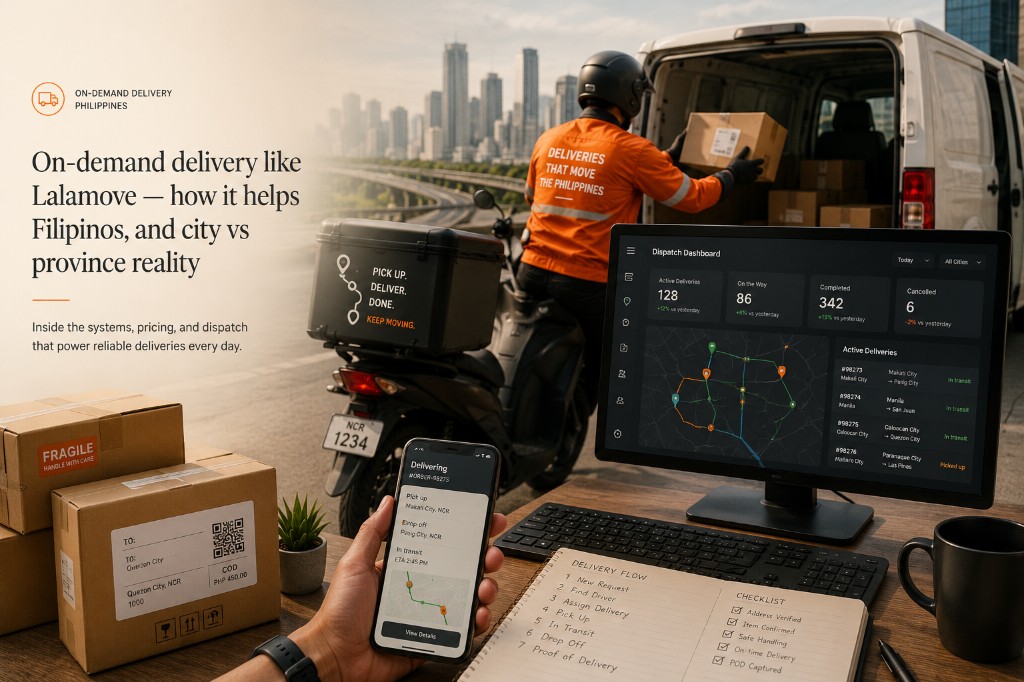
On-demand delivery like Lalamove — how it helps Filipinos, and city vs province reality
Logistics and on-demand delivery in the Philippines — how Lalamove-style apps help sellers, city vs province launch reality, and what ops + software need.
Your cousin in Cebu City sells skincare on Facebook. Order drops at 2 PM. A rider picks up from her condo, drops at a condo in IT Park, customer gets it before dinner. Same day. No warehouse. No company van.
Your tita in Bukidnon sells the same product. Customer asks for "padala now." Nearest rider app says no drivers nearby — or the quote costs more than the serum.
Same country. Different on-demand delivery reality in the Philippines.
That's the model Filipinos know from Lalamove and similar apps — logistics app developers here build customer apps, courier flows, and dispatch dashboards around it. Not just moving boxes. Moving trust for online sellers, small shops, and families who need something across town today.
I'm a logistics app developer in the Philippines — customer apps, courier/driver apps, admin dashboards, PHP backends. Production dispatch and delivery patterns ship at DSSI (Diverse System Solution Inc.). Here's how on-demand platforms help people here, what it takes to implement one for real ops, and the honest answer to: city first — or dare to launch in the province?
Logistics expertise · mobile app development · about · work
Who this is for: founders scoping a Lalamove-style product, provincial LGU or coop leaders wondering if delivery tech fits, online sellers, and developers who think maps + GPS = done.
What "Lalamove-style" actually means
Not a brand review. A product shape:
| Piece | Job |
|---|---|
| Customer app / web | Get quote, book vehicle type, track, pay |
| Driver / rider app | Accept jobs, navigate, proof of delivery |
| Dispatch / admin | Live jobs, assign override, pricing, payouts |
| Pricing engine | Distance, vehicle, surge, helpers, waiting time |
| Backend ledger | Job state, wallet, disputes, reports |
Vehicle types people expect: motorcycle, sedan, van, truck — move a document, a cake, or office furniture. Different from food delivery (one meal, one rider) and different from ride hailing (person, not parcel) — but the dispatch brain is cousins. See ride hailing post for trip-state patterns; food delivery post for marketplace economics.
How platforms like this help Filipinos
Online sellers and MSMEs
Shopee, Lazada, TikTok Shop — millions of sellers never owned a truck. On-demand delivery is their logistics department:
- Pickup from home or small bodega
- Same-day within the city when customer DMs "urgent"
- No hiring full-time rider on day one
Families and documents
Birth certificate to Manila. Meds to lola. Laptop forgot at office. Padala without asking a nephew who's already on overtime.
Restaurants and shops (without full food marketplace)
"I don't want GrabFood commission — I just need someone to move this tray to the client." Delivery-as-a-service, not a restaurant marketplace.
Small businesses going digital
Provincial hardware store quotes on Messenger, payment on GCash, needs rider — platform bridges the last mile when they can't run their own fleet.
Riders and side income
Another income lane for motorcycle owners — when supply rules and safety ops are real, not PowerPoint.
The social impact line: delivery platforms don't just convenience Metro Manila. They let small business compete on speed — but only where the network exists.
The job flow — what ops must support
Book → Quote → Assign driver → Pickup → In transit → POD → Payment → Payout → Rate
Proof of delivery (POD) — photo, signature, OTP — is non-negotiable for B2B clients.
Cancellation — customer ghosted, wrong address, item too heavy for bike.
Waiting time — driver at condo guardhouse 25 minutes. Who pays?
| State | Customer | Driver | Ops |
|---|---|---|---|
| Quoted | Sees price breakdown | — | Zone tariff OK? |
| Assigned | Driver details | Navigate to pickup | SLA clock starts |
| At pickup | "Driver arrived" | Confirm item, photos | Support on chat |
| Delivered | Receipt | Earnings | Dispute window |
Software that skips states becomes phone calls to your cousin who knows a tricycle driver. I've seen it.
City vs province — should you dare to implement?
Short answer: build for cities first, design for provinces.
Long answer below.
Why cities win for launch (Metro Manila, Cebu, Davao, Iloilo, etc.)
| Factor | City | Why it matters |
|---|---|---|
| Density | High | Enough jobs near enough drivers — match in minutes |
| Addresses | Messy but mappable | Guards, pins, "tapat ng 7-Eleven" — still a market |
| Online sellers | Concentrated | Volume of same-day demand |
| Payments | GCash/Maya normal | Cashless payout to drivers scales |
| Driver supply | Easier to recruit | Side-hustle culture, more bikes |
| Unit economics | Trips/hour higher | Spread fixed maps/SMS/support cost |
If you launch here: start one corridor (e.g. Makati–BGC, Cebu City core). Nail quote accuracy, POD, and driver accept rate before you say "nationwide."
Why province is harder — not impossible
| Challenge | Province reality |
|---|---|
| Sparse demand | One booking every 40 minutes — drivers go offline |
| Distance | Barangay to poblacion 12 km — quote must match fuel |
| Address chaos | Fewer pins; "kubò sa may bridge" — human support spikes |
| Cash preference | Still strong — reconciliation pain |
| Trust | New app vs known tricycle route |
| Internet | Dead zones on highway legs |
Dare to implement in province? Yes — with the right model, not a copy-paste of Metro Manila instant delivery.
Province models that actually work
- Hub-and-spoke — instant inside poblacion; scheduled between towns (morning run, afternoon run)
- Co-op or LGU partnership — tricycle/motorela fleet already exists; you digitize dispatch, not invent supply
- B2B anchor — one pharmacy chain, one bank branch network — guaranteed daily volume
- Inter-city lane — not "rider in 15 min" but same-day provincial corridor (e.g. Dumaguete ↔ Bacong) with known cutoffs
- Merchant-only first — web booking for shops; consumer app a later expansion when density proves out
Fantasy: nationwide Lalamove clone day one from a garage in Tagum.
Reality: prove one town square where sellers already DM "sino may padala."
City vs province — decision table for founders
| You have… | Start in… |
|---|---|
| Seed budget, no fleet partners | Major city, one zone |
| Co-op with 50 registered riders in one municipality | That municipality — hub model |
| B2B contract (clinic chain, documents) | Where the contract is — density from anchor |
| "Help our province" mission, thin funding | Scheduled delivery, not instant-on-demand |
| National ambition | City corridors first; province via partners, not hype |
Province isn't "no." Province is different product settings: longer ETAs, scheduled windows, maybe phone-assisted booking — still software, still ops, still POD.
Costs and third parties (same class as ride hailing)
Per booking, money leaks to:
- Maps / distance — quote wrong = subsidy or angry merchant
- Payment gateway — pay-in, refunds, driver wallet
- SMS / OTP — login and delivery codes
- Cloud + location pings — driver tracking writes add up
- Support — "driver took my cake" tickets
- Incentives — rain bonus, sign-up guarantees (optional but expensive)
A ₱120 moto padala might leave little platform margin after costs — volume or B2B contracts carry the model. Same lesson as ride hailing per-trip math.
What I'd build if you hire me
On-demand / logistics platform — Lalamove-style shape, your brand, your rules:
| Surface | Scope |
|---|---|
| Customer | Quote, book, track, pay, history, support |
| Driver | Job offers, navigation hook, POD capture, earnings |
| Admin | Live map, manual assign, tariffs by zone, payouts, disputes |
| Backend | PHP + MySQL, job state machine, role auth, audit trail |
First launch: one city zone OR one provincial hub + scheduled slots.
After launch: auto-dispatch, surge, merchant API for Shopee sellers.
Scale-up: multi-city expansion with separate ops playbooks — not one config for all.
Stack: Framework7 + Cordova for driver/customer apps when stores matter; web for merchants. Same production lane as my logistics expertise and e-commerce work.
Backend: PHP mini-framework post.
→ Logistics expertise · Mobile development · Full stack PHP · Contact
Tell me city vs province, vehicle types, instant vs scheduled, and expected jobs per day. I'll say straight if you need an app — or a co-op meeting first.
Bottom line
Lalamove-style delivery helps Filipinos when speed becomes possible — sellers ship trust, families move essentials, riders earn.
Cities are where you prove instant on-demand works.
Provinces are where you earn trust with hubs, schedules, and partners — not copy-paste Metro Manila marketing.
Dare to implement in the province? Yes — if you're not pretending density exists where it doesn't.
That's the logistics software I build.
Related on this site
FAQ
What is Lalamove-style on-demand delivery?
Customer books a courier job → quote → assign → pickup → deliver → proof of delivery. Instant on-demand in cities; often scheduled or hub-based in provinces where density is thin.
Should I launch on-demand delivery in a province first?
Usually no for instant — start in a city zone or run scheduled windows and hub partners in province. Pretending Metro Manila density exists everywhere burns budget.
Who uses on-demand delivery apps in the Philippines?
Online sellers, restaurants without full marketplace, families sending documents, clinics, and small businesses going digital — riders earn side income when ops is honest about ETAs.
How is logistics different from ride hailing?
Jobs are shipments or errands — not passengers. State machine resembles rides but adds merchant handoff, package photos, and B2B bulk upload in some products.
What does each delivery job cost the platform?
Maps, gateway fees, SMS, tracking writes, support, and incentives — similar leak class to ride hailing per-trip math. Thin margins need volume or B2B contracts.
What surfaces does a delivery platform need?
Customer, driver or courier, admin dispatch — PHP job state machine behind all three. Merchant web booking can follow once consumer volume proves out.
What is the hub or scheduled model for provincial delivery?
Thin instant density outside city cores — run pickup hubs, scheduled windows, or B2B anchor contracts instead of copying Metro Manila on-demand everywhere. Prove one corridor or hub first, then expand with separate ops playbooks per region.
What should I send when hiring a logistics developer?
City vs province, vehicle types, instant vs scheduled, jobs per day estimate, and whether merchants book via API or app only.
How long does a Lalamove-style first version take?
the first launch is one zone or one hub — months with flow sign-off, not national launch. Expansion is separate ops playbooks per region.
When is custom delivery software the wrong move?
No rider partners, no anchor B2B contract, and mission to “help the province” without budget for hubs and support — fix partnerships before another developer hour.