Blog
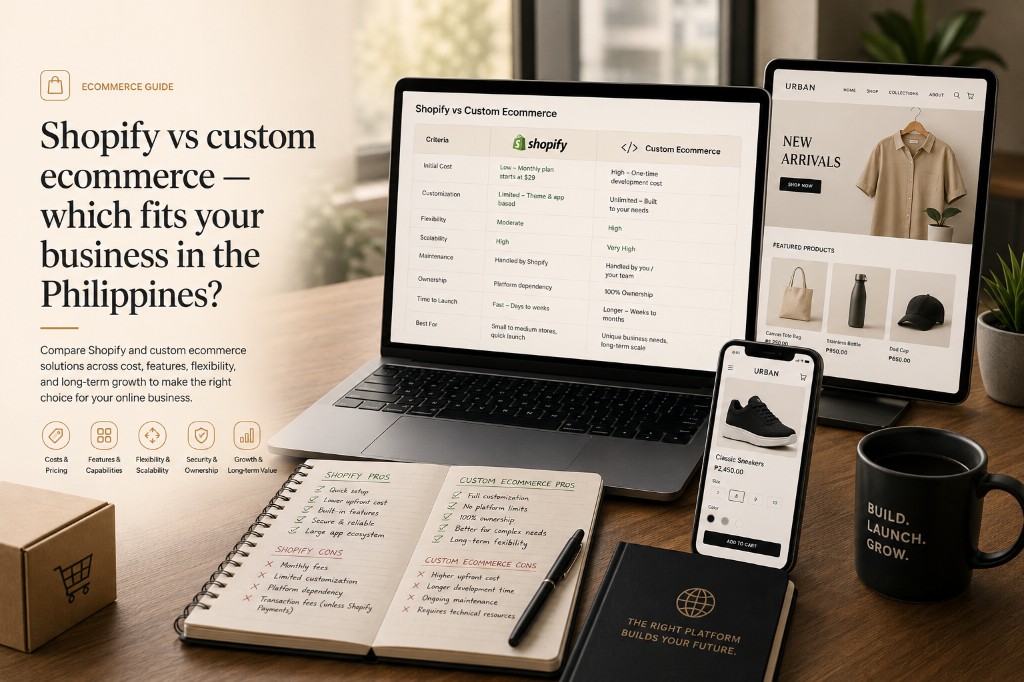
Shopify vs custom e-commerce — which fits your business in the Philippines?
E-commerce developer Philippines — Shopify vs custom platform. GCash, COD, costs, and when Filipino businesses should rent a store or own the engine.
You sold your first fifty orders on Shopee. Proof of concept done. Then the fees, the platform rules, and the customer who asks: "Do you have your own website? I want to pay GCash direct."
That's the Shopify vs custom ecommerce decision in the Philippines — rent a store fast, or own the engine.
Now you're staring at two paths:
Path A: spin up Shopify this weekend — theme, apps, payment link, live by Monday.
Path B: hire someone to build a custom e-commerce platform — catalog, checkout, admin, maybe merchant tools — software that bends to your business, not the other way around.
Neither path is automatically right. I'm an e-commerce developer in the Philippines — custom commerce and member platforms on PHP backends, mobile when needed. Commerce admin and multi-portal work also ships at DSSI (Diverse System Solution Inc.). I've watched founders burn cash on the wrong lane (Shopify for a marketplace, custom for a twenty-SKU hobby).
This is the honest split: Shopify (and SaaS shop builders) vs custom e-commerce — cost, control, operations, and when each wins for Filipino businesses.
E-commerce expertise · web development · about · work
Who this is for: brand owners outgrowing marketplaces, founders scoping a marketplace, and anyone who thinks "Shopify OR custom" is a personality test. It's a business model test.
Two models — rent a shop vs own the engine
| Shopify / SaaS e-commerce | Custom e-commerce platform | |
|---|---|---|
| What it is | Hosted store on someone else's product | Software built for your rules |
| Time to first sale | Days to weeks | Weeks to months |
| Upfront cost | Low — subscription | Higher — development |
| Ongoing cost | Monthly + apps + transaction % | Hosting + maintenance + features |
| Customization | Themes + plugins — inside guardrails | Deep — if you pay for it |
| You own the code | No | Yes |
| Best for | Standard catalog, D2C brand, fast launch | Marketplaces, weird checkout, heavy admin, mobile app tie-in |
Shopify is the name everyone Googles. The trade-offs apply to similar SaaS builders too — I'm not picking on one logo. The real question is rent vs build.
How Shopify-style platforms help Filipino businesses
Let's be fair — SaaS shops exist because they work.
Speed. Pick a theme, upload products, connect payments, share link on Facebook. No sprint with a developer.
Payments. Shopify Payments, PayPal, and integrations for local methods — less wiring on day one.
Hosting & security. SSL, updates, uptime — not your midnight panic (mostly).
Apps. Email, reviews, inventory, SEO plugins — ecosystem does the long tail.
Trust. Customers recognize a polished checkout. "Legit website" energy for a new brand.
For a single-brand store — clothes, skincare, coffee, merch — selling hundreds of SKUs with normal checkout, Shopify is often the correct first move.
Where Shopify starts to pinch
The pain shows up when your business stops being a catalog with cart.
| Need | SaaS reality |
|---|---|
| Multi-vendor marketplace | Plugins exist — gets fragile and expensive |
| Membership + store + booking | Three apps that barely talk |
| Custom commission per seller | Spreadsheet + prayer |
| Philippines COD workflows | Awkward — confirm, cancel, fake orders |
| B2B price tiers | Plugin maze |
| Own mobile app sharing cart/login | API limits, workarounds |
| Warehouse + rider dispatch in same system | Wrong tool — that's logistics software |
| "When X buys Y, notify admin and hold stock 24h" | Custom script or manual ops |
Every app adds monthly fee. Every plugin update risks breaking checkout before payday.
You're not failing. You graduated past rented infrastructure.
Custom e-commerce — what you're actually buying
Custom doesn't mean "fancy website." It means your operations encoded in software:
| Layer | Typical scope |
|---|---|
| Storefront | Catalog, search, cart, checkout, account |
| Payments | GCash, Maya, cards, COD flags, partial pay |
| Merchant admin | Products, orders, refunds, reports |
| Marketplace admin | Sellers, commissions, approvals, payouts |
| Integrations | Courier API, ERP, SMS, email |
| Mobile | Framework7/Cordova app sharing same PHP backend |
Order state again: placed → paid → packed → shipped → delivered → returned. Marketplace adds: seller accept → split payout → dispute.
I ship this with PHP + MySQL admin density and mobile when the product needs it — same lane as food delivery and e-commerce expertise on my site.
Backend habits: PHP mini-framework post. AI-assisted build with human review: AI web developer pros/cons.
Cost honesty — Shopify vs custom (illustrative)
Numbers shift by plan, apps, and dev rates. Directional only.
Shopify lane (year one, small D2C brand)
| Item | Illustrative range |
|---|---|
| Shopify subscription | ~$29–$110+/mo |
| Apps (email, reviews, COD helper) | $50–$200+/mo |
| Transaction fees | % per sale + gateway |
| Theme / design | $0–$500 one-time |
| Year one total | Low thousands USD if sales are modest |
Cheap to start. Costs climb with GMV and app stack.
Custom lane (year one, first version marketplace)
| Item | Illustrative range |
|---|---|
| Discovery + process flow | Fixed scope |
| Build (store + admin + payments) | Developer quote — often mid five to six figures PHP for serious first version |
| Hosting | ₱2k–₱15k+/mo depending traffic |
| Maintenance | Retainer or per sprint |
| Year one total | Higher upfront — flatter % of GMV later |
Custom hurts at invoice one. Custom wins when platform fees + plugins + workarounds would exceed build cost over 18–36 months — or when the model is impossible on SaaS.
Break-even question: Will you pay Shopify + apps + dev workarounds for three years — or own the engine once?
Philippines-specific — what local businesses actually need
| Local reality | Shopify | Custom |
|---|---|---|
| GCash / Maya checkout | Integrations — verify fees | Wire exactly how you want |
| COD with confirmation step | Clunky | First-class order state |
| Facebook / TikTok traffic | Fine — link to store | Fine + custom promo logic |
| Seller in province, manual payout | Pain | Payout ledger built in |
| Tagalog admin for staff | Theme strings | Your copy, your training |
| Lawyer wants audit trail | Export hacks | Admin logs by design |
Marketplace graduates from Shopee often need custom not because Shopify is bad — because they're building a platform, not a single shop.
Decision guide — pick in five minutes
Choose Shopify (or SaaS) if:
- One brand, one catalog, standard checkout
- You need live this month
- Team is marketing-heavy, tech-light
- Budget is tight upfront
- Ops can live in apps + spreadsheets awhile
Choose custom if:
- Multi-vendor marketplace is the product
- Checkout rules are non-negotiable and weird
- You need deep admin + mobile app + same backend
- Commission, wallet, membership, or booking tied to commerce
- You're planning 3+ years on this software — ownership matters
Hybrid (common): Shopify for D2C while custom admin runs wholesale B2B — messy but real. Or Shopify first, custom later when revenue proves model. I've seen both.
Brochure or SEO-first site? Different brief than product commerce — see web development services for how I split lanes.
What founders get wrong
- Custom on day one for a 20-SKU hobby — overkill
- Shopify forever for a 200-seller marketplace — expensive fiction
- Ignoring COD fraud — whichever lane, confirm flow matters
- No admin plan — merchant calls you to change price
- "Mobile app later" without API design now — rebuild incoming
What I build — custom e-commerce in the Philippines
| Deliverable | Notes |
|---|---|
| Process flow | Order, payment, refund, seller rules documented first |
| Storefront | Web — React/Next or PHP — scoped to project |
| Admin | Catalog, orders, users, reports, roles |
| Marketplace | Seller onboarding, commissions, payouts (when scope says so) |
| Payments | Gateway integration + COD states |
| Mobile | Optional — Cordova app on shared backend |
Not included: pretending Shopify is always wrong, or custom is always worth it.
→ E-commerce expertise · Full stack PHP · Mobile development · Contact
Send catalog size, single vs multi-vendor, payment methods, and must-have day-one. I'll tell you Shopify — or quote custom — honestly.
Bottom line
Shopify rents you a proven store — fast, polished, right for many Filipino D2C brands.
Custom e-commerce owns the engine — for marketplaces, messy ops, and businesses that outgrew plugins.
The comparison isn't which tool is cooler. It's whether you're selling products or building a platform.
That's the commerce work I build.
Related on this site
- E-commerce expertise
- Logistics blog — last-mile after checkout
- Food delivery blog — own channel vs marketplace cousin
- Work portfolio
FAQ
When should a Philippine business use Shopify?
Single brand, standard checkout, need live this month, marketing-heavy team, tight upfront budget — Shopify or similar SaaS fits many D2C brands.
When is custom e-commerce worth it in the Philippines?
Multi-vendor marketplaces, messy checkout rules, commission and wallet logic, deep admin plus mobile on one backend, or a three-year platform bet where you own the engine.
How much does Shopify cost vs custom year one?
Shopify: subscription plus apps plus transaction fees — predictable rent. Custom: higher build, lower recurring platform tax if you own hosting — break-even depends on GMV and plugin pain.
Can Shopify handle GCash, Maya, and COD?
Integrations exist — verify fees and confirm flows. Custom lets you wire COD states and confirmation steps exactly how ops works.
Is Shopify wrong for marketplaces?
Shopify is a store, not a multi-seller platform core. Two hundred sellers on plugins is expensive fiction — marketplace graduates usually need custom or specialized marketplace SaaS.
What does a custom e-commerce build include?
Process flow, storefront, admin, payments, optional marketplace modules, mobile on shared backend — scoped in phases. See e-commerce expertise.
Can I start on Shopify and migrate to custom later?
Common hybrid path — prove revenue on SaaS, rebuild when plugin limits hurt. Plan API and data export early if migration is possible.
What should I send when hiring for e-commerce in the Philippines?
Catalog size, single vs multi-vendor, payment methods, COD fraud concerns, admin users, and mobile day-one vs later.
How long does custom e-commerce first version take?
Depends on marketplace rules, payouts, and mobile scope — months with agreed scope locked in month one, not “Shopify timeline.”
Do you recommend Shopify to avoid custom work?
Yes when the brief is honestly a single shop — I will say Shopify when it fits. Custom when you are building a platform, not decorating a template.